Showing posts with label testing. Show all posts

Thursday, June 19, 2014

Proctoring clash at Independence High

What do you get when you mix the tension of testing, a surreptitious video by one of CMS' most prolific critics and a school police officer on a Segway?

Answer: A buzz about what happened when Larry Bumgarner volunteered to proctor exams at Independence High and ended up being escorted off campus and threatened with arrest.

Bumgarner
Bumgarner, a three-time school board candidate, calls the incident an example of  "goon squad"  tactics by Charlotte-Mecklenburg Schools.

Earnest Winston,  the superintendent's chief of staff,  says Principal Amy Dellinger and her staff acted appropriately when Bumgarner became disruptive during state testing.

Adding to the tension is the fact that the presidents of the district's two teacher groups,  Judy Kidd of the Classroom Teachers Association and Charlie Smith of Charlotte-Mecklenburg Association of Educators,  work at Independence and have different views of what happened.

Here's what I know:  Many schools were in desperate need of proctors in May.  State exams that have consequences for schools and teachers are supposed to get outside monitors to ensure the integrity of the system.  Schools have to be careful that nothing occurs during testing that would violate state rules and invalidate the results.

Kidd
Bumgarner posts frequently on the Observer's web site,  usually about the shortcomings of CMS and the superiority of charter schools.  But he also volunteers to proctor at his alma mater,  West Charlotte High,  and Kidd asked if he'd do the same at Independence.

Bumgarner agreed.  He and CMS officials agree that during his first day as a volunteer he made a remark about working in  "troubled"  or  "challenged"  schools.  A student's grandparent overheard the comment and complained to school administrators.

During his stint as an Independence proctor,  Bumgarner also used his phone to shoot video of students in the classroom.  At least four had their heads down,  and one,  who had a blue sneaker perched on his desk,  glared at Bumgarner and shook his head.  Bumgarner said Wednesday the students had gotten noisy when the teacher left the room and he shot the video to quiet them.

The next day,  someone from Independence told Bumgarner he wasn't needed to proctor.  Kidd,  who says proctors were still needed,  called Bumgarner.  He came to the school and reported to a classroom that already had a proctor.  Bumgarner was told again that he wasn't needed.

Smith says he saw that part of the encounter,  and Bumgarner was  "pitching a fit."

"He just stormed off,"  Smith said Wednesday.  "He was irate and he was very rude.  Everybody that I saw trying to deal with him was extremely professional and extremely polite."

Bumgarner went to the classroom where Kidd was stationed to proctor an exam.  A campus security guard showed up,  and that's when Bumgarner turned the phone on his belt onto video mode.  In the recording that ensues,  Bumgarner repeatedly urges the guard to call Mint Hill police and asks to talk to the principal.

"You're going to the office and you're getting ready to be arrested,"  the security guard says.  "You have come here and disrupted testing.  Have you lost your mind,  mister?"

Bumgarner continues talking as they approach the school resource officer's office.  "I'm tired of your mouth. Now shut up,  you understand me?"  the guard says.

The school resource officer wheels up on a Charlotte-Mecklenburg Police Department Segway,  and Bumgarner is taken into the school security office. The decor captured on the video features an American flag and a life-size shooting-range target with bullet holes clustered around the center of a human silhouette. Other security staff gather in the office, but when Dellinger arrives she disperses them.

In the calm but disjointed conversation that follows,  Bumgarner tells Dellinger that he did  "show my displeasure"  with what he considered a disorganized volunteer system,  in which he and other volunteers were sent to rooms that already had proctors.

"This is the first year where our North Carolina finals have ever had proctoring,"  Dellinger responds.  "We had 87 testing sessions,  67 proctors.  That's a first in history."

Dellinger tells Bumgarner she got complaints about his comment that  "I only work at troubled schools."

"Why do you feel that Independence is a troubled school?"  she asks.  "I'm just curious.  I want to get feedback.  It helps us grow."

Bumgarner asks for  "a Q&A"  with the concerned family members,  refers to his web sites and urges Dellinger to look up her school on GreatSchools.org,  a site where people submit reviews.  "I assume I'm under arrest,"  Bumgarner states,  and when Dellinger assures him he's not,  he says he's going to go play golf.

"I want to extend my apology on behalf of us,"  Dellinger tells Bumgarner,  adding that she should have asked him earlier about his remark.

Bumgarner,  who was escorted out by a security staffer,  says he called the superintendent's office to report the episode.  He said Wednesday that Dellinger and the school officer were polite,  but the talk of arrest was threatening and the atmosphere,  including the Segway,  is designed to intimidate.  He said he is disappointed that he has not gotten an apology from CMS.

Winston said he spoke with Bumgarner and Dellinger,  and  "I don't have any evidence that anything was done incorrectly or that Larry was mistreated in any way."  Winston said he heard about the  "troubled schools"  comment,  but said Dellinger told him that wasn't why Bumgarner was turned away.  Instead,  he said,  he was told the school simply had enough proctors that day.

"That's a lie,"  said Kidd,  who said the teacher across the hall from her was trying to find a proctor as Bumgarner was being led away.  "They should not have kicked the man off campus,"  she added.

Friday, May 23, 2014

Kids can read during test time

There's a new N.C. twist to testing this year:  When students finish early, they can read books or magazines until the whole class is done.  State Superintendent June Atkinson sent a memo to superintendents this week reminding them of the change.

One might wonder why the state's top educator would bother calling attention to a relatively minor change buried deep in the state's 158-page testing manual.  The answer:  It's part of a complex negotiation between state officials and parents who plan to refuse to let their kids take exams.

Atkinson

As I reported earlier,  Deputy Superintendent Rebecca Garland wants to make it clear that North Carolina doesn't consider testing optional.  Parents may want to protest what they view as misuse of testing to rate teachers and schools,  but kids who refuse to answer questions will get a zero,  which could drop their class grade and bring other consequences.

After Garland's  "no opt-out"  memo went out,  parents with Mecklenburg ACTS met with Atkinson to argue that even if the kids get zeroes,  they shouldn't be forced to  "sit and stare"  if they're protesting.  The group suggested that Atkinson provide guidelines that note state disapproval of opting out but offer districts  "child-centered"  ways to handle refusals.

The message that went out doesn't specifically address test protesters,  but it's understood that some of the kids will be finishing very early.

"This is a good thing not just for students who are refusing the test,  but for those who finish the tests early.  Previously,  they had also been forced to sit and stare,  sometimes for a couple of hours,"  says Pamela Grundy,  one of the organizers of the opt-out push.

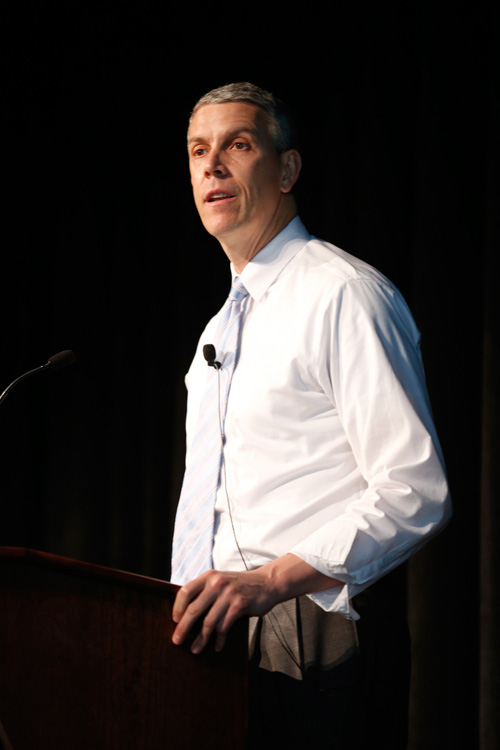
Duncan at EWA
North Carolina is part of a national testing resistance movement.  In New York City more than 30,000 students opted out this spring,  high school principal Carol Burris told education reporters at the Education Writers Association national seminar in Nashville earlier this week.

The uses and misuses of testing were a big topic there.  U.S. Education Secretary Arne Duncan emphasized the importance of setting high standards and using rigorous tests to measure student progress:  "We had so many states that dummied down standards to make politicians look good."  The Obama administration's  Race to the Top grants have pushed the use of student test scores to evaluate teachers,  but he acknowledged that some states have gone overboard on testing.

"Where there's too much,  we need to have the honest conversation and scale it back,"  Duncan said,  without citing which states he referred to.

Tennessee officials were quick to credit tougher tests with the state's significant math gains on recent  "nation's report card"  tests.  Several speakers,  including Gov. Bill Haslam,  noted that the state went from a state testing system that labeled 90 percent of eighth-graders proficient in math,  earning the state an F in truth in advertising from the national Chamber of Commerce,  to one that more accurately reflects a bleaker reality.

Dennis Van Roekel,  president of the National Education Association,  said misuse of student scores to create  "value-added"  ratings of teachers has created rebellion among teachers and families.  "Teachers are not opposed to tests,"  he said.  "We invented them."

Tommy Bice,  Alabama's state superintendent,  talked about his state's rollout of a testing system for grades 3-12 based on the ACT.  The series of exams measure everything from basic reading and math skills to college and work readiness.  But Bice said Alabama has made a decision that sets it apart from many states:  It uses the scores only to shape instruction,  not to rate schools,  teachers or even students.

"Once we begin to use this powerful assessment tool for something other than what it was designed for,"  he said,  "it becomes something else."


Tuesday, May 20, 2014

Do charters play on a level field?

When I wrote about the latest round of charter school approvals,  reader Carrie Diane posted a series of questions about charter schools.   "Before I get anyone upset, I'm just asking questions here because I honestly do not know the answers,"  she began.

That's a challenge. Discussion of the pros and cons of charter schools has been going on for more than a decade in North Carolina.  Some people have strong views and come out sniping.  Meanwhile,  others are just entering the conversation and get frustrated when they read articles that don't include all the background.

This reader posed some good questions that require more than an online comment section to answer.  So here's my stab at them,  and I'm sure the rest of you will jump in.

First:  When I read that charter schools get on average $2,000 less than public schools my first thought was that isn't that supposed to be because they are marketed as being more effective and efficient than a public school? I realize it is less money, but I was truly thinking that wasn't that part of the allure of creating charter schools? 

I wasn't covering education when the state launched charters in the 1990s,  but my understanding is that rather than saying  "Let's see if we can do the same job with less money,"  the founders wanted to see if charter operators could do a better job with roughly the same money.  The most recent study I've seen pegs the gap at just over $1,700,  but most of that comes from the fact that counties don't have to provide money for facilities, as they do for district schools.  The system is set up to give charter schools the same per-pupil state allotment for operating costs that all other public schools get on average,  and requires counties to do the same.  Of course,  needs and spending vary dramatically from school to school,  whether they're charters or traditional.

Next: Are we comparing apples and oranges when it comes to testing and measuring success? My impression is that charter schools do not have to follow the same EOG testing measures and Read to Achieve that a public school does. 

Charter schools have to give the same state exams and report the same results.  Check state school report cards (where you can also find per-pupil spending reports) or click the School Data links at the right of this column to see mapped results for Charlotte-Mecklenburg Schools and Mecklenburg charter schools.  Charter schools get more flexibility under Read to Achieve to deal with third-graders who fall short on reading skills.  But unlike district schools,  charter schools face closure for repeated poor performance on state exams.

And this: Are charter schools and public schools working along the same guidelines when it comes to teacher qualifications? 

No.  All teachers in traditional public schools must be licensed,  but charters can fill up to 50 percent of their teaching spots with unlicensed teachers.

And finally,  Carrie Diane questioned why charter schools don't have to offer busing and free lunches and how that affects serving low-income students.

This one gets complicated.  Charter schools have to have plans to ensure that no student is denied admission because of transportation or meals.  But that doesn't have to mean busing and cafeterias.  Some charters cover transportation by helping families connect for car pools and expect families to send or buy lunches.  They say they'll provide individual meal assistance and do what it takes to ensure that students from low-income families can get to school.  But some say disadvantaged families don't apply to charter schools that make it difficult.

Advantage charters?  Well,  not so fast.  CMS has a large and expanding menu of magnets and other opt-in schools with limited transportation.  And those schools often set admission requirements,  which most charters can't do.  Finally,  the biggest factor in school demographics is location.  Schools in east and west Charlotte tend to have high poverty levels and low white enrollment,  whether they're charters or district schools.  Those in Mecklenburg's suburbs and surrounding counties generally have much lower poverty levels and more white students,  regardless of who's running them.

So no,  charters and districts aren't playing on a level field.  But it's not always clear who's got the edge.

Monday, April 7, 2014

Standardized tests: Opt out or buckle down?

As the testing season nears, the debate over the value of those exams is heating up, locally and across the country.

Bryan
On April 21,  a group of Charlotte-Mecklenburg Schools parents are holding a forum on  "How did testing get so out of control and what can we do about it?"  Sparked by Selwyn Elementary parents concerned about the testing demands imposed by North Carolina's Read to Achieve program,  the event will be from 7-8:30 p.m. at Alexander Graham Middle School,  1800 Runnymede Lane.  Panelists will be UNC Charlotte literacy professor Bruce Taylor,  state Rep. Rob Bryan and Pamela Grundy of Mecklenburg ACTS.

Grundy's group is taking part in the national  "Testing Resistance and Reform Spring" movement,  which encourages parents to opt their students out of exams.  You may have seen the recent opinion piece by Grundy and her husband,  Peter Wong,  about why their seventh-grade son won't take state exams.

"During nearly a decade of experience with high-stakes testing, we have become increasingly appalled at the damage we have seen it do to schools and children,"  they wrote.  "... Elected officials from both parties have failed us.  It is time for parents  –  who have the biggest stake in high-quality public education  –  to just say no."

Michelle Rhee,  former chancellor of Washington, D.C, schools, recently weighed in on the opposite side in the Washington Post.
Rhee


"Opt out of measuring how well our schools are serving students?"  Rhee writes.  "What’s next: Shut down the county health department because we don’t care whether restaurants are clean? Defund the water-quality office because we don’t want to know if what’s streaming out of our kitchen faucets is safe to drink?"

Read more here: http://obsdailyviews.blogspot.com/2014/04/why-our-son-wont-take-eogs.html?showComment=1396400619199#storylink=cpy

N.C. Deputy Superintendent Rebecca Garland recently sent a memo to superintendents reminding them that the state does not allow opt-outs.  Students who refuse to take state exams will receive failing grades,  the memo says,  and those who stay home on testing day will be given a makeup exam when they return.


Monday, March 24, 2014

Charters, tenure, testing and Project LIFT

It's a good week to learn more about education, with an array of public meetings and forums taking place.

At 3 p.m. Tuesday,  Mecklenburg County commissioners will hear a presentation from Charlotte-Mecklenburg Schools about the county money that's passed along to charter schools.  Some commissioners want to know more about how that money is being spent and whether they can exercise any control.  As required by law,  CMS is passing along about $25 million from this year's $356.5 million allocation to cover costs for almost 11,000 Mecklenburg students enrolled in charters.  With 11 new charters opening in the Charlotte area in 2014-15,  CMS projects it will take another $7.5 million to cover almost 2,300 more charter students.

Pine Lake Prep in Iredell County serves Mecklenburg students
The special commissioners' meeting,  in room CH-14 of the Government Center,  is open to the public.

At 6 p.m. Tuesday,  the CMS board will vote on its version of the controversial  "25 percent plan" to phase out tenure (details of the CMS plan have not yet been released)  and the district's 2014 legislative agenda.  The agenda also includes a report on academic achievement at the Project LIFT schools. That meeting,  in Room 267 of the Government Center, is also open and streamed online.

Cobitz
At noon Wednesday,  Wingate University Ballantyne kicks off a "lunch and learn"  series with assistant professor Chris Cobitz talking about  "What's all this testing in schools about?"  Cobitz is a former testing official with CMS and N.C. Department of Public Instruction.  Bring your own lunch and attend the session at Suite 150 in the Harris Building, 13024 Ballantyne Corporate Place.  (It'll be like Throwback Wednesday if I can make it; I worked extensively with Cobitz and Lloyd Wimberley,  director of the graduate school of education, when they were with CMS.)


Stuckenberg
As they say in the late-night infomercials ... but wait!  There's more!  You can cap off this education marathon by hoisting a mug at  6:30 p.m. Wednesday at Heist Brewery in NoDa,  where there's a  "Policy and Pints"  session scheduled.  Just keeping up with new education advocacy groups these days is a challenge:  This one is sponsored by N.C. Policy Bridge,  a  "grassroots and top roots"  organization trying to get teachers more engaged in public policy discussion.  Kayti Stuckenberg,  a CMS middle school teacher,  is one of the organizers.  Adam Rhew of MeckEd,  which is helping promote the meetings,  says the core group is young teachers associated with Teach For America.  To attend,  RSVP here.

Update: Just found out CMS lawyer Jonathan Sink and CMS administrators will also be at the Tuesday Breakfast Forum this week  (8:30 a.m. at the West Charlotte Rec Center) speaking about the state's charter school law and the district's desire to have similar flexibility.

Saturday, March 8, 2014

CMS high school teachers hosed on ratings?

The irony was obvious last spring:  Charlotte-Mecklenburg Schools didn't trust the state's new final exams enough to count them toward high school students' grades.  But those tests were created to rate teachers,  so teachers not only had to give the exams but spend hours grading new open-ended questions.

Now the results of the teacher effectiveness ratings are in,  and they indicate something went awry in rating CMS high school teachers.

Across the state and in CMS,  more than three-quarters of all teachers met or exceeded the goal for student gains.  But when I broke that out by grade level,  more than 80 percent of teachers in CMS elementary,  middle and K-8 schools met or exceeded the goal,  compared with just over 60 percent of CMS high school teachers.

Erlene Lyde at West Charlotte


I also ran the numbers for more than 12,700 non-CMS high school teachers around the state,  and 78 percent of them met or exceeded the target.

It's possible that these numbers reveal a real shortcoming unique to CMS high school teachers.  But a handful of  teachers and principals I spoke with questioned the results on two grounds:  The validity of the tests and the fact that CMS teens knew they had no stake in scoring high.  Erlene Lyde, a West Charlotte High teacher and vice president of the Charlotte-Mecklenburg Association of Educators,  put it most bluntly:  "Flawed data generated from flawed tests administered in flawed conditions and graded using a flawed scoring mechanism."

Thus, the perpetual challenge:  I think it's important to analyze and report on education data.  But at the same time,  you have to question what the numbers really mean.

I'm still not sure how well the EVAAS formulas from SAS Institute turn student test scores into meaningful measures of school growth and teacher value. But the EVAAS site for looking up school growth ratings is one of the best public data presentations I've seen.  It's a simple matter to look up schools and make comparisons in a number of different ways  (fellow geeks, check out the scatterplot option under comparison reports).

School growth and teacher effectiveness are both based on students'  year-to-year progress on state exams.  As you'd expect,  schools that score well on one measure are likely to look good on the other.  But they're not identical for a number of reasons.  One of them is that school growth is based only on End-of-Grade and End-of-Course exams,  while the teacher ratings include more tests.

Some of you asked excellent detail questions when those ratings first came out. I asked Jennifer Preston of the N.C. Department of Public Instruction to clarify the tests used and the way student results were assigned to teachers.  Here's her report,  for those who are interested in diving deep:

  • The Department of Public Instruction and the SAS Institute were able to provide teacher-level value-added data for a pretty expansive list of grades/subjects and courses.  They are: Reading/ELA in Grades 4 – 8, Mathematics in Grades 4 – 8, Science in Grades 5 – 8, Social Studies in Grades 5 – 8, Biology, Earth/Environmental Science, Chemistry, Physics, English I, English II, English III, Algebra I/Math I, Geometry, Algebra II/Integrated Math III, World History, Civics and Economics, United States History, American History I, and American History II.  These estimates are all based on the administration of End-of-Grade assessments, End-of-Course assessments, and NC Final Exams.  North Carolina has also had a well-established Career and Technical Education assessment program for many years; teachers of more than twenty-five Career and Technical Education courses received individual value-added scores.  
  • In order to ensure that all value-added estimates are fair and valid, we do have some safeguards in place around minimum student counts.  For End-of-Grade Assessments in Science, End-of-Course Assessments. NC Final Exams, and the CTE State Assessments, teacher must be connected at least ten students and the equivalent of six "full students," defined as students with 100% instructional responsibility claimed by one teacher.  This point is most easily explained with examples.  Let's say that an Exceptional Children's teacher has claimed 20 students at 10% instructional responsibility for each one.  While the teacher is connected to ten students, he is only connected to the equivalent of two "full students" (20 students X 10% each = 2 full students). The teacher will not have a value-added score because he is connected to fewer than six "full students."  A different Exceptional Children's teacher has claimed 20 students at 50% instructional responsibility for each one.  This teacher is connected to at least ten students, and is connected to the equivalent of 10 "full students."  He will have a value-added score.  Each of the students must have at least three prior test scores (in any grade/subject or course) in order to be used in the analysis.  For End-of-Grade Assessments in English Language Arts and Mathematics (Grades 4 – 8), a teacher must be connected to six "full students," using the same terminology as described above.  These business rules are to ensure the quality of the value-added data – if a value-added estimate is calculated using a very small number of students, it's simply not valid.  While a bit complicated, these rules simply reflect the reality of teaching today – there are lots of cases in which teachers share instructional responsibility for students and work as a team to provide them with the services they need.


Friday, February 21, 2014

Testing boycott and teacher ratings

A snowstorm, an earthquake  --  and now we have Pamela Grundy and Pat McCrory on the same side of an education issue. The end times must be here.

Grundy, a founder of Mecklenburg ACTS and Parents Across America,  is urging parents to boycott state exams this spring,  part of a national  "Testing Resistance and Reform Spring"  protest against excessive testing.  Other sponsors are FairTest,  United Opt Out,  the Network for Public Education and Save Our Schools.

Grundy and Carol Sawyer of Meck ACTS
So far there aren't a lot of details about the boycott.  Charlotte-Mecklenburg parents have talked about keeping their kids out of testing in the past;  the official stand is that tests are part of the curriculum and parents aren't allowed to opt out.

McCrory,  the Republican governor,  probably doesn't support the boycott.  But he did get vocal about the hazards of overtesting at last week's Emerging Issues Forum on teachers.   (Speaking of which,  anyone interested in issues raised at that forum can sign up for a free online course on world-class teaching,  sponsored by N.C. State's Emerging Issues Institute.)

No one's arguing against kids taking tests to show what they know.  The controversy springs from the barrage of N.C. exams designed primarily to rate teachers and schools.  A lot of folks who want solid data about the quality of public schools say the state is going too far in the quest to generate numbers that may or may not capture teacher quality.

Meanwhile,  we just got a first look at how those test-generated ratings play out for N.C. schools and districts.  I'll be eager to hear what people are thinking as they check out data on their schools.  The state's site makes it easy to look up schools and districts,  but it's tough to do any kind of big-picture comparison and analysis looking up one data point at a time.  State officials say they'll send me a spreadsheet as early as today.  If you'd like a copy,  shoot me an email at ahelms@charlotteobserver.com with  "spreadsheet"  in the header.

I caught up with Julie Kowal,  executive director of CarolinaCAN,  after I'd filed the story on value-added ratings.  Her group is big on data and accountability,  so it was no surprise to hear her say that  "the wonk in me"  loves this report:  "It is so valuable for the state to make this publicly available in the way they have. We need this data to be able to make responsible decisions."  But she added a note of ambiguity:  "The parent in me thinks it's very difficult to know what it's good for."

Tuesday, February 11, 2014

The latest twists in testing

Charlotte-Mecklenburg third-graders will have a broader menu of reading tests to help them earn promotion without summer school,  assuming the snow-crossed school board approves at a meeting this morning (after snow canceled the Jan. 28 meeting,  tonight's regularly scheduled meeting has been bumped up to 11 a.m. to avoid a repeat).

As you may recall,  districts around the state are trying to put the Read to Achieve law into practice without sending thousands of children to summer school or drowning them in exams. The goal is ensuring that students who move up to fourth grade have grade-level reading skills.

More than 2,500 of this year's CMS third-graders can relax:  They tested at third-grade level on new state reading exams given at the start of this year,  so they don't have to worry about being retained or sent to summer school based on an end-of-grade reading score. The rest,  about 78 percent of the class,  will have these options to demonstrate proficiency:

* MAP tests being given in most elementary schools.

*  Discovery Education reading tests being used at Project LIFT schools.

* Reading 3D tests created by Amplify  (where former Superintendent Peter Gorman went to work).

*  Or the state's "portfolio"  reading tests,  which sparked controversy because they require students to pass quizzes on 36 passages.

Students who don't make the grade on any of these options will have to see if they pass the End of Grade exam.  If not,  they'll have to take summer reading camp to be promoted.

The state granted the request of CMS and 15 other districts,  including Cabarrus,  Gaston,  Hickory,  Kannapolis,  Mooresville and Union County,  to have additional testing options.  But you can see why testing is such a thorny topic in the state,  with Gov. Pat McCrory saying the volume  "borders on the absolute ridiculous."

But former Gov. Jim Hunt, hosting an Emerging Issues Forum focused on teachers, warned against a knee-jerk reaction to overtesting.  He recalled a day when too many were oblivious to how little students were learning.

"The whole issue of testing is one that we've got to do a lot of hard thinking about,"  Hunt said.  "We must figure out whether students are learning and how to help them learn more."


Tuesday, February 4, 2014

Third-grade reading: Less testing, more flexibility?

A panel of educators and parents studying North Carolina's Read to Achieve program will ask lawmakers for fewer tests,  more flexibility and a one-year reprieve in mandated penalties for kids who fail exams,  the state Department of Public Instruction announced today.

The Read to Achieve Advisory Group's recommendations will go to the state legislature when it convenes in May.  Meanwhile,  the state Board of Education will consider proposals to relieve the testing burden on many local school districts at Wednesday's meeting.

The program is designed to make sure third-graders can read well before moving up,  a goal almost everyone supports.  But the specifics have proven problematic,  especially a  "portfolio"  option designed as an alternative to passing a one-time state exam.  In its current version,  students who want to demonstrate reading proficiency through the portfolio have to pass 36 small reading assessments between now and year's end.

Charlotte-Mecklenburg, Cabarrus, Cleveland, Gaston, Hickory, Kannapolis, Mooresville and Union County schools are among the 16 districts seeking approval this week for alternative testing approaches  (read their proposals here; click item II-B2 for a link).

In the longer run,  the advisory panel is asking the legislature to scale back portfolio testing,  give school districts more flexibility in school calendars and summer reading camps,  and count the current year as a trial run for Read to Achieve.

Lynn Bonner at the News & Observer reports that Senate leader Phil Berger, the law’s champion, doesn’t like that last part.

“No,” Berger said in a statement. “It’s wrong to let another class of third graders slip through the cracks. Passing them along unprepared has not solved the problem before, and it is not a solution now.”

Read more here: http://www.newsobserver.com/2014/02/04/3590879/berger-pops-read-to-achieve-trial.html#storylink=cpy

Monday, January 27, 2014

Hot topic for 2014: Common Core and testing

As state legislatures convene in 2014,  look for renewed debate about Common Core academic standards and the testing that comes along with it,  says Pam Goins, director of education policy for the Council of State Governments.

Goins
"Rising numbers of stakeholders are questioning the Common Core State Standards Initiative, state assessment systems and teacher evaluation models. Of the 45 states that adopted the common core, as many as 20 states may re-open the discussion on rigorous academic standards,"  Goins wrote in a news release last week. "The remaining states likely will review their commitment to overhauling state assessment and accountability systems."

That's certainly true in North Carolina,  where questions about testing are raging and the state is moving toward new exams developed by the Smarter Balanced Assessment Consortium that will provide cross-state comparisons of higher-level skills.

In addition to assessment and accountability, the council pegs the top five education issues for 2014 as expanding access to early childhood education,  increasing college/workforce readiness,  figuring out the best uses of digital learning and increasing college completion.

Those all sound on target for our state,  though I'd add teacher compensation and charters/choice to North Carolina's hot-topic list for 2014.  Any other big items on your radar?


Tuesday, January 21, 2014

Questions about state's final exams

The "incomplete" grades expected to show up on Charlotte-Mecklenburg high school report cards soon may be just the start of an uproar over state exams that are causing delayed grades.

North Carolina created 30 final exams that will be used to evaluate teacher and school effectiveness  --  and which have to count for 20 percent of students' final grades in those courses. After I wrote last week about delays in translating those scores to letter grades,  I heard from a handful of teachers and parents who said the exams don't match the material being taught.

"My son is a junior in high school and this past week had to take his honors pre-calculus exam.  On that exam were four questions never covered in the curriculum," wrote Anita Gimon of Union County. "Why is there subject matter on a test not in the curriculum during the semester? This was a problem as well last year. Students who normally made 80s & 90s on their tests were averaging 40s because the test did not match the curriculum. This seems to me to be a system that sets our kids up for failure."

"My daughter took the Math 3 exam yesterday and was pretty upset afterwards," wrote Susan Flynn.  "Half of the material was familiar to her, about half was not."

"The passages from the test last year  --  the only available preparatory material released by the state  --  are incredibly difficult and would be considered challenging in an AP-level course.  I know, because I teach standard, honors, and AP English 12,"  wrote Tiffany DiMatteo, a national board certified English teacher at Myers Park High.  "It feels as though NC wants to prove that students and teachers are failing by providing a terrible test that is being poorly planned, administered, and scored."

Chuck Nusinov,  executive director of learning and teaching for CMS,  says he has checked into that kind of concern.  The tests do appear to match the curriculum introduced last year,  which reflects national Common Core and N.C. Essential Standards,  he said.  The academic standards and the exams are designed to ensure that students learn more rigorous material and express that knowledge in more sophisticated ways on tests,  he said.  That should be a good thing in the long run,  but in the short run it means scores are down.

Nusinov says the challenges and confusion are particularly strong in math,  where the state also switched from a series of algebra and geometry classes to a new progression of math classes that incorporate various skills each year.  He said CMS is working to make sure teachers know what's expected,  but he knows teachers and students are struggling with the transition.

Students took the new finals last year,  but CMS opted not to count the scores toward grades because the tests were new.  This year it's not optional.  So first-semester report cards are expected to come out with incompletes for classes with state finals,  to be replaced with letter grades that factor in those tests once the state completes its tables for converting raw scores to grades.  That's bound to come as a shock to students who are used to making higher grades and who are watching their grade-point averages for college admissions.

Monday, January 20, 2014

Read or flunk: It's way more complicated

In a summer headline,  I dubbed North Carolina's  "Read to Achieve"  program the  "read or flunk plan."  The mandate from the state legislature does threaten third-graders with retention if they can't pass reading tests.  But six months later,  as state and local officials grapple with options,  it's becoming clear that the route from third grade to fourth grade is more like a maze than a forked path.

The first branch,  as it turns out,  has already happened.  Soon after this school year began,  third-graders took new Beginning-of-Grade reading exams  (yes, we now have a BOG test).  Late last week,  Charlotte-Mecklenburg Schools learned that students who scored at third-grade level on that test will be eligible for promotion without having to worry about the barrage of tests they encounter during the rest of the year,  spokeswoman Kathryn Block said.  CMS is working on a count of how many children cleared that hurdle.


Students who pass the End-of-Grade reading test in May will also be cleared for promotion.  But last year fewer than 50 percent of third-graders in CMS and North Carolina cleared that bar.  That means some 6,000 students in CMS alone are at risk of getting bad news at the end of the year,  and it's impossible to be sure which students might fall short.

That's why districts like CMS and Wake County are planning to make sure all students who might be at risk have a chance to get onto another path to promotion by demonstrating grade-level skills on a series of smaller  "portfolio"  tests.  The current plan means those students will have to read 36 passages and answer questions on them between now and May.  CMS is going to the state Board of Education next month to seek approval for an approach that involves fewer tests.

Another fork comes for students who fall below grade level on the portfolio and the final exam.  They'll be offered the chance to attend summer reading camps,  which by state mandate will be three hours a day for six weeks.

If parents decline to send the kids, they'll be held back.

Think about that one for a minute.  As a working parent who doesn't get summers off,  I know how hard it would have been for me to get my son to a three-hour program,  then find another place for him to be for half the day and get him there.  If parents can't or won't do it for whatever reason,  their children don't move up to fourth grade.

CMS is seeking state permission to substitute a three-week,  six-hour camp,  a schedule officials hope will be more practical for parents and more attractive to the skilled reading teachers they want to hire for those sessions.

For those who do go to summer reading camp,  there is  (what else?)  another chance to take a test.  If they pass, great.  If not,  they can be assigned to a combined third/fourth-grade class or to an "accelerated learning"  class with extra reading instruction.  Those kids can be deemed ready for mid-year promotion to fourth grade.

And if all that isn't complicated enough,  there are also exemptions for students with disabilities or limited English proficiency.  And here's the one that had steam coming out of some CMS leaders' ears:  Charter schools have more flexibility about participating in the Read to Achieve maze.  Read the CMS presentation here or view the school board's discussion here  (because of a problem with video archiving,  the recording starts in the middle of the staff report on Read to Achieve,  but the full follow-up discussion is available).

Thursday, January 16, 2014

Why sue? Just tweet

The frontiers of social media expanded just a little during Tuesday's school board meeting,  when three public officials tweeted plans to solve a problem that was still under discussion.


The Charlotte-Mecklenburg school board was getting a staff briefing on the challenges of the state's  "Read to Achieve"  mandate.  A flood of new testing for third-graders and rules that give charter schools more flexibility than traditional public schools drew strong criticism from board members.

I was tweeting from that discussion.  State Rep. Tricia Cotham,  a Democrat and former CMS educator,  and state Rep. Charles Jeter,  a Republican who serves on the House education committee,  were following from a distance.  So was school board member Rhonda Lennon,  from her computer at the dais.

At one point,  board member Ericka Ellis-Stewart asked if the board was willing to sue to block the most onerous portions of the law.

I tweeted Superintendent Heath Morrison's response: Morrison on legal action: Better to work with legislators, who seem receptive to revising . Lawsuits are last resort.

Jeter
Jeter responded: Absolutely willing to work together to resolve these issues. If something needs fixing, let's do it together.

Lennon

Lennon: Charlie let fix this ... Read to Achieve creating chaos for traditional LEAs, charters not burdened by same laws

Jeter: Rhonda, I'm in, let's fix it.

Cotham
Lennon: will you join us to fix this ?

Cotham: Of course!!

Lest someone think that Lennon should have been voting instead of tweeting, let me note that there was no action required. In fact, a reasonable person might conclude that staff reports about controversial state mandates, such as Read to Achieve and teacher tenure changes, are more of a public performance than a chance for the board to get up to speed. Members get the details in advance, and the staff presentations tend to be followed by board members' remarks about hardship to CMS and the importance of mobilizing the public to weigh in.

I'm not naive enough to think Tuesday night's Twitter flitter will solve a very complex problem. But I am hopeful enough to think there are officials on both sides of the aisle, at the state and local level, who want to work past the significant snarls in last summer's state mandates to tease out the valuable goals.

Before our lawmakers return to Raleigh in May, it's a smart time for parents, teachers and others who care to get up to speed on the issues and let their representatives know what they want. It's easy to look up contact info at the N.C. General Assembly web site (if you aren't sure which district you're in, look up your voter registration).

I'd suggest you also check out the CMS presentation on Read to Achieve, but oddly, the version posted online eliminates six crucial pages on testing and other "challenging points" from the version that was presented to the board and reporters that night. (Update: A full version has been posted.) Even more perplexing: The video of the meeting starts well into the session, with one of deleted pages on screen and Chief Learning Services Officer Valerie Truesdale reviewing summer school requirements.


Wednesday, November 27, 2013

Could new exams close N.C. charters?

North Carolina charter schools will get a one-year reprieve from academic standards that could lead the state to revoke charters. But the tougher new tests that debuted last year,  leading to a dramatic plunge in pass rates across the state,  could spell trouble for many schools moving forward.

Seventy-five of 108 charter schools that reported scores for 2013 fell below the 60 percent composite pass rate that can trigger a label of  "academically inadequate." That's not a surprise,  given that fewer than half of all public-school students (including traditional public schools and charters,  which are operated by independent boards) passed last year's math and reading exams.  And it's actually better than schools run by local districts:  By my tally, 86 percent of North Carolina's district schools and 69 percent of charters had pass rates below 60 percent.  (See results for Mecklenburg schools in the school data listing at right.)

Charlotte's Sugar Creek Charter had low proficiency but high growth
State law defines charter schools as academically inadequate if they have composite pass rates below 60 percent on state exams and  "no growth in student performance"  for two out of three consecutive years.  One charter has been closed since those standards were set in 2011 and several others have been  "put on notice"  that they're at risk,  Joel Medley,  director of the N.C. Office of Charter Schools,  said in a recent letter to charter operators.

But a 60 percent pass rate on the old tests isn't the same as 60 percent on the new exams,  which are designed to test the more complex skills demanded by national Common Core academic standards.  In fact,  I'm still puzzling over how anyone can accurately calculate year-to-year student growth,  given that the testing has changed so much. School growth ratings are now tallied by the Cary-based SAS, a private company that uses a secret formula to determine whether N.C. schools met, exceeded or fell short of acceptable progress.

The state Board of Education decided not to penalize anyone for 2012-13 scores,  Medley said,  but this year's results will count and could combine with earlier years to label a school inadequate.  By Dec. 19,  Medley said,  he'll notify operators if their school is at risk.

Eighteen of the charters that fell below 60 percent also failed to meet the state growth targets.  Those included four in the Charlotte area:  American Renaissance School in Statesville (38.7 percent overall proficiency),  Carolina International School in Harrisburg  (50.2 percent),  Community Charter in Charlotte  (17.8 percent)  and Crossroads Charter High in Charlotte (less than 5 percent).

Closing of  inadequate charters is not automatic. Update/correction: Medley called Monday and said under the current system, revocation is automatic for schools that fail to meet the standards for two of the most recent three years (which will not include 2012-13).

My guess is there's going to be a lot of discussion among charter advocates, state education officials and lawmakers about the definition of the label.   After all,  if falling below 60 percent proficiency and failing to make growth targets are indicators of academic failure ,  many traditional public schools also fell short last year,  including Charlotte-Mecklenburg's Hopewell  (33.7 percent),  Independence  (45.3 percent)  and Myers Park  (58.5 percent) high schools.

Friday, November 22, 2013

No second chance on 2013-14 exams

N.C. students won't get a second chance if they flunk state exams this year, Vanessa Jeter of the Department of Public Instruction told me this week.

Before the new exams rolled out in 2012-13,  students who fell short were required to take the tests again  (different questions on the same material). If they passed on the second try,  it counted toward school proficiency rates, a significant bump for many struggling schools.

This year,  the only students who will be retested are those who fail third-grade reading exams.  The state's new Read to Achieve program spells out a series of actions that are triggered by failure on those tests,  starting with retesting and potentially leading to summer school and retention. (See the process on page 4 of this guide.)   Based on this year's results,  a lot of children aren't clearing the bar at the end of third grade.  See elementary school proficiency rates,  including the percent who passed third-grade reading,  on this new results map.

A second year of one-shot testing could be bad news for schools facing state-issued letter grades in 2014 (see 2013 results for all Charlotte-Mecklenburg schools and Mecklenburg charter schools in the rail at right).  The same goes for CMS high school students,  who will see 25 percent of their final grades in math I, English II and biology shaped by their score on the state tests.

But Superintendent Heath Morrison argues it will be good news for people trying to monitor how much progress schools make this year.  Before the state made it clear whether retesting would be revived this year,  he argued against it for the sake of having two consecutive years of comparable results.  In 2014-15,  the state is slated to switch tests again,  introducing Smarter Balanced Assessment Consortium exams designed to reflect national Common Core standards and provide a consistent testing system among participating states.

"We would prefer to keep the testing as similar as possible,"  Morrison told the school board.

Monday, October 21, 2013

Student journalism thriving in CMS

I loved seeing a swarm of eager high school journalists at Friday's Strategic Plan 2018 event at the Booth Playhouse.


Charlotte-Mecklenburg Schools ensures that student reporters get to cover big district events,  and the numbers seem to be growing.  I've recently spoken with students and advisers starting new publications at South Meck and Mallard Creek High,  and even at South Charlotte Middle School. About a dozen high schools had journalists there. (Read a CMS feature on one of South Meck's student reporters, Clarissa Brooks, here.)

The students asked good questions about teacher pay,  crowded classrooms and how standardized testing meshes with the creative approach Superintendent Heath Morrison pushed in his speech.  That last one got one of the best answers I've heard Morrison give.

"I'm not anti-test.  I am for a more limited number of tests,  high-quality tests that measure 21st century stuff,"  Morrison said.  He gave an example:  Old-style testing might ask students to list the first 10 presidents,  something any of them could quickly look up online.  A better question,  he said,  would be asking students to write about important decisions the early presidents made that shape life today.

Coming to these events exposes teens to one of the most exciting aspects of journalism:  The chance to be in the thick of current events and ask questions of people who shape our lives.  Even before Morrison's news conference,  they made connections among the people gathered for the event,  such as  Dorothy Counts Scoggins,  who made history as a school integration pioneer.

South Meck's Alton Peques interviews Scoggins

Journalism certainly needs the fresh ideas and new blood.  But I'm sensing one disconnect:  At a time when communication is increasingly reliant on multimedia,  school journalism tends to be decidedly retro.  Some schools put out print newspapers that take weeks to produce.  Many have online editions,  but few seem able to do real-time reporting,  create and post videos and otherwise develop the skills that would help them get jobs in the field.  Don't get me wrong;  good writing is always going to be vital.  But I marvel to think what these young folks could do with even the tools I have at the Observer.  (Morrison's presentation included a great two-minute example of using video to communicate the point about open-ended vs. fixed-answer questioning.)

School newspaper advisers are doing the best they can with the skills and resources they've got.  But I'm wondering if there's not some way to match up the professionals out there who do multimedia work with the students who could put the technology to such great use  (and make great employees a few years down the road).  I'm trying to put bugs in a few ears.  Meanwhile,  if you're a school journalist or a professional,  I'd love to hear your thoughts.

Monday, October 14, 2013

How do you test the tykes?

Remember the math, reading, science and social studies tests CMS created for grades K-2?  They required one-on-one work with an adult,  brought protests from parents and teachers who considered them a waste of time and were quickly dropped.

So we know how tough it is to design good tests for the youngest kids.  But N.C. education officials say it's a vital task to make sure students develop the skills they need before they fall behind.  The K-3 N.C. Assessment Think Tank,  a group of teachers,  parents and education experts convened by the state legislature and state Superintendent June Atkinson,  has released its first report on designing assessments that help young children learn.

"Now, more than ever, a major focus of education must turn to the early years of elementary school (kindergarten through grade 3) when children are poised to begin a trajectory toward success in school and life,"  the report says.

The Charlotte-Mecklenburg Schools exams were given at year end and were intended to generate ratings of teacher effectiveness.  These assessments will be given during the year,  with the goal of figuring out what kids need  (formative assessments, in eduspeak).  They'll include observations,  work samples and other measures,  in addition to any pencil-and-paper testing.

The first report outlines the type of skills that should be measured,  ranging from language to health and emotional development.  Another group will be convened to design the assessments.  The goal is to have kindergarten pilot exams in place in about half the state's districts in 2014 and a full program up by 2015-16,  according to the Public School Forum of North Carolina.

Thursday, September 26, 2013

Score one for CMS on data accuracy

Last year's CMS seniors didn't log any math gains on the SAT, but the folks who run the district made a big step forward in demonstrating their own ability to report numbers.


When the College Board released its 2013 SAT report today,  I downloaded the school by school report from the N.C. Department of Public Instruction and looked at the Charlotte-Mecklenburg Schools news release.

The numbers for CMS didn't match.

Barnes
That's not the surprise.  As many of you know,  there have been instances in years past when CMS numbers didn't add up.  And too often,  the people who released those numbers weren't prepared to explain.

Today, Chief Accountability Officer Frank Barnes was ready.  Before the scores went public his staff had checked the data they got from the College Board against the state report and caught a problem:  The state report didn't include Garinger High.

That omission made CMS look better.  Without the 142 tests from Garinger,  the CMS average was 1480,  one point above the state average.  With them,  CMS fell to 1473  (still a 10-point gain over 2012).

The CMS news release used the lower and more accurate scores.  It discussed the possibility that lower participation might have contributed to gains.  It mentioned that a school was missing from the state report -- and when I asked Barnes what Garinger's score was he gave it to me, even though the score of 1218 out of a possible 2400 was second-lowest in CMS.  He said he's working with state officials to get the Garinger scores added to state calculations.

"We wanted to report what we knew to be true,  even if it was lower than the state report,"  Barnes said.

All of this adds up to a promising sign that Superintendent Heath Morrison is delivering on his promise to make sure numbers are correct before they're released and to be honest about strengths and shortcomings.

Morrison was hired in 2012, as CMS was grappling with the embarrassment of badly botched school progress reports.  The first time I talked to him,  he said he was going to create systems to avoid such errors and provide honest explanations if mistakes did happen.

The first few weeks brought stumbles.  When state exam results were released in August 2012,  CMS declined to release results for West Charlotte and Harding high schools,  which were not given a state rating because they didn't test enough students.  The result:  A front-page story when I got the numbers from the state and they turned out to be the two lowest-performing schools in the district.

Since then it's been hard to judge.  Changes in state testing have delayed the exam results that usually land in the summer.  CMS still hasn't launched its own school ratings,  trying to make sure they mesh with a state system that's in flux.

The big test will come in November,  when the state releases 2013 exam results. It looks like CMS may be ready.

Wednesday, September 25, 2013

Student's view: Don't grade me on teacher tests

Leave it to a teenager to put a fresh spin on a topic.  At a school board meeting earlier this month Celia Collias, a junior at Myers Park High,  joined a group urging Charlotte-Mecklenburg Schools to resist adding more state exams that are being created to rate teachers.

Her argument:  It's not fair to count those exams toward student grades.  After all,  if they really measure teacher effectiveness,  a low score just means we had a bad teacher,  right?

She's far from the first person to question the tests,  known as Measures of Student Learning. Local parents,  teachers and advocates have aired doubts about the value of the exams and the time they take away from other classroom work.  So have board members and Superintendent Heath Morrison.  State and federal education officials are still mulling whether to delay the plan to add more MSLs this year.

Still,  Celia's analysis made me smile.  She highlighted a kind of Catch 22:  The tests are supposed to measure teacher effectiveness.  But of course student effort  (not to mention intelligence,  preparation and mood that day)  shapes the scores.  Officials say the exams should count toward final grades to motivate students to give it their best shot.  So if students try hard and still get a lousy score their grade drops,  even if it's the teacher's fault.

The folks who support value-added ratings for teachers  --  and there are many who do, all across the country  --  would say that's oversimplified.  They say they can create formulas that tease out the teacher's contribution to student success or failure.  But it's not clear whether regular people  --  not to mention teachers whose careers are at stake  --  believe them.

Two years ago,  CMS officials made a valiant effort to create a value-added formula and explain it to employees and the public.  I think it's fair to say they failed.  Backlash was strong,  including parents threatening to keep their kids home on testing days.  Key players,  including Superintendent Peter Gorman and performance pay director Andy Baxter,  left CMS and the new crew quickly dropped the effort.

Dr. William Sanders and the Cary-based SAS Institute say they have a formula that works.  It's well regarded in national education circles,  and N.C. education officials have hired them to crunch state test scores for teacher evaluations.  But the rest of us can't examine that formula because it's how SAS earns its income.  Morrison has raised doubts about pinning his teachers'  evaluations to a formula that can't be fact-checked.

So stay tuned.  The quest to create better teacher evaluations is an important one.  We'll be hearing plenty more about this.  And Celia and her classmates will be waiting to learn whether new state exams will shape their grades this year.

Wednesday, September 4, 2013

Pushback on NC exams

State education officials and superintendents,  including Heath Morrison in CMS,  have asked U.S. Education Secretary Arne Duncan for a reprieve on using state exams to rate teachers.  The N.C. Board of Education is slated to take the matter up this week.

Now local teachers,  parents and advocates want to take things a step further.  The Charlotte-Mecklenburg Association of Educators and Mecklenburg ACTS will ask the Charlotte-Mecklenburg school board to boycott new state exams known as  "measures of student learning"  even if Duncan doesn't grant permission. The two groups are preparing a petition to present to the CMS board at its Sept. 10 meeting.

Duncan

"At a time of shrinking school budgets,  rising class sizes and plummeting teacher morale,  more tests are the last thing our schools need,"  says a news release sent out this week.

MSLs are exams given in addition to the end-of-year math,  English and science exams that are used to gauge student proficiency and rate schools.  They were created to measure teacher effectiveness in additional subjects.  Duncan has the final word because the state pinned its Race to the Top grant application and request for a waiver from No Child Left Behind to use of those tests in teacher evaluations.  Now the state wants more time to work out valid tests and make sure they're used properly to rate teachers.

According to the CMAE/MeckACTS resolution,  the MSLs given last spring were  "deeply flawed,"  "poorly designed"  and a waste of time and money.  "As a community,  now is the time to stand up for public schools and stand against statewide mandates for new,  excessive and unneeded standardized tests,"  it concludes.

In his weekly report to the school board,  Morrison said he and other superintendents want a chance to develop their own methods of estimating student growth and teacher effectiveness,  rather than being forced to administer more state exams this year.